Part 1: Organisation Design & Development: Aligning Operating Models with Company Growth Stages and Institutionalisation Levels
As organisations progress through startup, scaleup and maturity, their HR structural, cultural and operational requirements evolve. Organisation Design (OD) and Organisational Development (OD) play important roles in understanding these changes and ensuring that the organisation develops the capabilities, structures and ways of working required to achieve its objectives.
However, the arrangements needed to support a growing, entrepreneurial or a scaling up business are not necessarily the same as those required in an established, mature organisation. The leadership and organisational design required during these stages are not the same as those needed to manage traditional, day-to-day operations in a more stable environment. A common mistake is assuming that a successful HR leader in a conventional setting can seamlessly transition to leading in a startup or scaleup. In reality, while a leader experienced in driving startup or scaleup growth can later manage conventional operations, the reverse is seldom true.
Developing an organisation requires more than establishing departments, defining reporting lines or introducing policies and procedures. It requires an understanding of business performance, cultural dynamics, institutional development and the different stages through which organisations evolve.
In this two-part series of articles, I will explore a methodology for understanding organisational maturity, diagnosing structural and cultural context, and aligning organisational design and development with business objectives. Rather than focusing on conventional Human Resources (HR) practices, the emphasis is on institutional analysis, organisational effectiveness and the design of appropriate operating models.
This first article examines the levels and types of organisational institutionalisation, how they influence organisational structures and decision-making, and the different approaches to managing people that emerge as organisations develop. These concepts provide the foundation for designing an organisation that is fit for its purpose, stage of development and competitive environment.
1. Understanding levels of institutionalisation
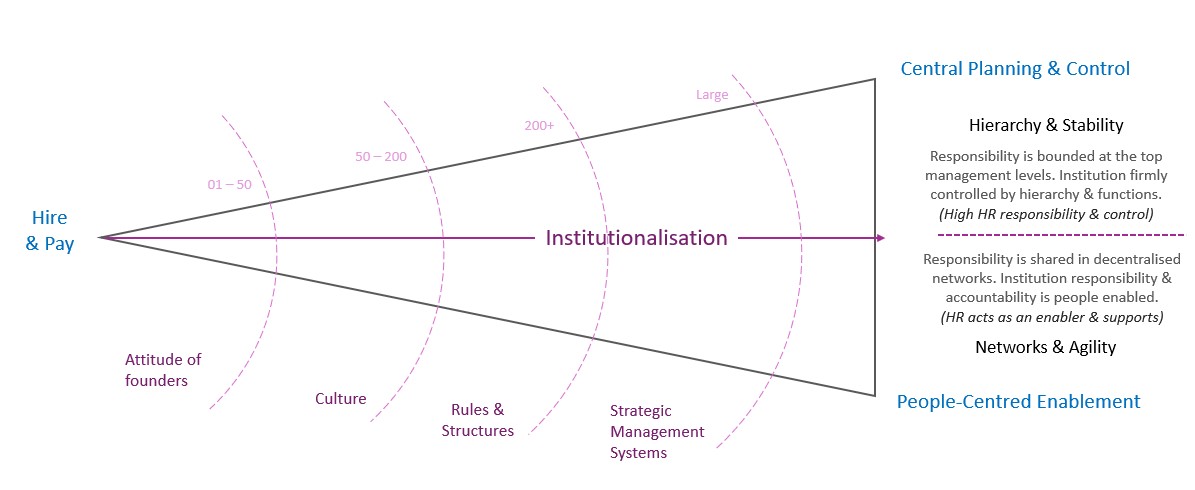
Organisational development occurs across two key dimensions: growth in size and the evolution of institutionalisation.
From inception to maturity, organisations progress through different stages. As they develop, their operating arrangements tend towards one of two broad institutional orientations: Hierarchy & Stability or Agility & Networks.
The extend towards either orientations is inherently neither right or wrong. Each has its advantages and limitations, and its suitability depends on the nature of the industry, the business model, the competitive environment and the organisation's strategic objectives.
The HR leader understanding of these two orientations enables executive leaders to assess whether the existing organisational arrangements remain appropriate or whether change and restructuring are necessary.
These institutional characteristics are also essential when designing the people operating model. They influence how the People function operates, how it engages with stakeholders and business functions, how responsibilities are distributed, and how policies, processes and compliance arrangements should evolve. A one-size-fits-all approach is unlikely to work across different stages of organisational development.
1.1. Attitude-Driven Stage (1 – 50/70 employees)
In the early stages of a startup, typically from inception to around 50–70 employees, the founder's attitude and behaviour tend to dominate the organisation.
Decisions, actions and everyday ways of working are heavily influenced by the founder's personal values, leadership style and expectations. The organisation is largely informal, personal influence outweighs formal rules, and employees adapt their behaviour to reflect the founder's approach.
At this stage, the organisation's identity and ways of working are often closely associated with the founder. Formal structures and processes may be limited, with decisions made through direct communication and personal relationships.
1.2. Culture Development Stage (50 – 200 employees)
As the organisation grows beyond approximately 50 employees and towards 200, the founder can no longer be directly involved in every decision or interaction. The need for an organisational culture becomes increasingly apparent.
Culture consists of shared norms, values and implicit assumptions about how things are done. It shapes employee behaviour even when the founder is not directly involved.
Often, the emerging culture reflects the founder's original attitudes. For example, if the founder values trust and prioritises customer satisfaction, these principles may become embedded in the organisation's culture, guiding employee behaviour and decision-making.
At this stage, culture becomes an important mechanism for reducing complexity, maintaining cohesion and enabling consistent behaviour without the need for exhaustive rules and procedures.
1.3. Role and Structure Development (200+ Employees)
Once an organisation grows beyond approximately 200 employees, culture alone is generally insufficient to manage increasing complexity. Clear roles, responsibilities and organisational structures become increasingly important.
Formal processes and systems begin to define who is responsible for what, how work should be carried out, and how decisions are made. As functional departments emerge, the delegation of authority and accountability becomes critical.
Even routine matters, such as business travel, may require formal guidelines. These might define who is eligible to travel for business, which class of travel is permitted, how much can be spent on meals, and what limits apply to car hire.
Such arrangements help streamline operations, ensure consistency, reduce uncertainty and provide clarity across the organisation.
1.4. Strategic Management Systems Stage (Large Organisations)
As the organisation continue to grow and mature, strategic management systems become increasingly important.
Beyond individual attitudes, culture, roles and structures, organisations require integrated systems capable of managing complex operations and supporting competitive advantage. Examples include Customer Relationship Management (CRM), Supply Chain Management (SCM), Human Resource Information Systems (HRIS) and financial management systems.
These systems manage significant volumes of data, coordinate complex processes and provide the infrastructure needed for efficient, scalable operations.
Strategic systems also connect different functions, support organisational alignment and enable leaders to make informed decisions that sustain long-term growth.
The progression described above is a conceptual framework rather than a universal rule. Employee numbers provide indicative reference points; the complexity, risk, operating model and nature of the business will influence when each level of institutionalisation becomes necessary.
2. Types of Institutionalisations: Hierarchy & Stability versus Agility & Networks
The previous section examined how organisations develop through different levels of institutionalisation. We now turn to the types of institutionalisation, which can be visualised as a spectrum or as two opposing hemispheres representing different organisational tendencies.
These orientations influence decision-making, the distribution of responsibility, accountability and the way structures operate. For simplicity, this article examines the two ends of the spectrum.
2.1. Hierarchy and Stability
At one end of the spectrum is the Hierarchy & Stability model.
In this approach, decision-making authority and responsibilities are concentrated towards senior management, supported by clearly defined functional responsibilities, formal roles and established reporting lines.
Organisations leaning towards this orientation often feature strong hierarchical structures, distinct divisions of labour and clearly defined controls. Functional silos may emerge, with authority and accountability residing primarily with senior leaders.
The emphasis is on maintaining stability, ensuring consistency and reducing ambiguity through established rules, procedures and decision-making protocols.
This orientation can be valuable where standardisation, control, predictability and clear accountability are critical to operational effectiveness.
2.2. Agility and Networks
At the opposite end of the spectrum is the Agility & Networks model.
Here, responsibility is decentralised and shared across networks of employees and teams. Rather than relying exclusively on a rigid hierarchy, decision-making is distributed, and accountability is enabled through collaboration, transparency and shared ownership.
The emphasis is on flexibility, innovation and empowering individuals to take initiative.
Structures are designed to facilitate collaboration and enable people to respond to changing circumstances, rather than relying exclusively on top-down controls.
This orientation can be valuable in environments where innovation, specialist expertise, adaptability and rapid decision-making are important to organisational success.
Applying the two orientations in a real business context
To better understand these two institutional hemispheres, let's apply this on business travel to provide a practical illustration of how these institutional orientations influence everyday organisational decisions.
Agility & Networks: a decentralised approach
In an organisation operating towards the Agility & Networks end of the spectrum, travel policies may be flexible, with relatively few rigid rules. Employees are trusted to make decisions in the company's best interests.
For example, an employee might be empowered to book a business-class flight or luxurious room in a five-stars hotel where they believe it is justified by the circumstances, without seeking prior approval, provided they can demonstrate that the decision benefits the organisation.
However, autonomy is accompanied by transparency. The organisation might publish travel expenditure against the overall business budget through an internal platform or intranet, using graphs, charts and comparisons to show how much each employee or department has spent on business travel.
This approach promotes accountability by making decisions visible and encouraging employees to act responsibly. Trust and shared responsibility are central, while organisational arrangements enable individuals to make decisions and remain accountable for their choices.
Hierarchy & Stability: a centralised approach
By contrast, an organisation leaning towards Hierarchy & Stability is more likely to have rigid and clearly defined business travel policies.
For example, the policy might specify the permitted class of travel according to an employee's grade and the duration of the flight, hotels and meals specific budgets. Any deviation, such as an upgrade to business class or expenditure above the allocated budget, would require approval from the employee's manager, the CEO or, in some circumstances, the Executive Leadership Team (ELT).
Decision-making authority is centralised, and employees are expected to follow established protocols. This creates a predictable environment in which roles, responsibilities and approval processes are clearly defined.
The emphasis is on control, consistency and maintaining order throughout the organisation.
Comparing the two approaches
These two ends of the institutional spectrum illustrate fundamental differences in how organisations are structured and managed.
Hierarchy & Stability prioritises control, order and consistency, with decision-making authority concentrated towards the top of the organisation. Agility & Networks emphasises shared responsibility, decentralisation and flexibility, empowering employees to make decisions within a networked framework.
Both approaches have merits. The appropriate balance depends on the organisation's size, industry, growth stage, risk exposure and competitive environment.
Some organisations benefit from the stability and control of a hierarchical approach; others thrive through the flexibility and innovation enabled by decentralised decision-making. Many will require a combination of both, with different arrangements for different activities, functions or levels of risk.
The objective is not to select an orientation simply because it is fashionable, but to understand the organisation's existing institutional characteristics and determine whether they support its strategic objectives.
The above was an example in a minor compliance part such as business travel policy. You can apply this on talent development, performance and even across all business unit. Industries that need high standard conformed operation, quality controls and standardisation, lean towards a hierarchy and stability (e.g. factories, hotels, airlines, etc) while industries that aims towards value add, creativity and innovation, lean towards agility and networks (e.g. Tech & software development, professional services, etc.)
3. How institutionalisation shapes the People function
Having examined the levels and types of institutionalisation, we can now explore how these characteristics influence the role of HR.
Just as organisations differ in their approaches to structure, decision-making and accountability, they also differ in how they manage people. The appropriate People operating model depends, in part, on the organisation's level of institutionalisation and its chosen balance between central control and decentralised responsibility.
The methodology identifies three broad approaches:
- Hire & Pay
- Central Planning & Control
- People-Centred Enablement
These approaches represent different ways of distributing responsibility for people-related activities. They are conceptual models rather than a mandatory sequence: an organisation may combine elements of more than one approach.
3.1. Low Institutionalisation: "Hire & Pay"
At the earliest stage of institutionalisation, HR is primarily concerned with the most basic functions: hiring and paying employees.
This approach is typical of young, small organisations with little or no formal HR infrastructure. An official HR department may not exist, and people-related responsibilities may be managed by the founder, finance or operational managers.
Recruitment is often ad hoc, with limited consistency or formalised processes. There may be no standardised approach to performance appraisal, employee development or succession planning. Compensation may be similarly unstructured, with salary payments representing the most consistent HR-related activity.
The organisation may not yet have implemented a formal Human Resource Management System (HRMS), and the term HR may not even be used internally.
This represents a low level of HR institutionalisation, where formal processes, systems and governance have yet to develop.
3.2. Central Planning & Control
As an organisation grows and institutionalises, it may adopt a more hierarchical approach to managing people.
Under the Central Planning & Control model, HR operates through centralised authority and takes responsibility for most employee-related processes. This approach is often associated with organisations that prioritise stability, consistency and predictability.
If asked who is responsible for recruitment, learning and development, or identifying high-potential employees, the answer would be the HR department.
HR acts as the gatekeeper for people-related processes, maintaining oversight of recruitment, career progression and employee development.
For example, a talented employee might be identified by HR and senior management as a high-potential individual. Their development would then follow a predefined career path, with specific training programmes, development objectives and progression steps determined by HR.
Recruitment operates similarly. When a department needs to recruit, HR may take ownership of the process, from gathering requirements to screening and selecting candidates, while the business function plays a more limited role.
Although this is an extreme illustration, many organisations continue to operate with a highly centralised HR function in which authority and responsibility for people-related decisions rest primarily with HR rather than being shared across the organisation.
3.3. People-Centered Enablement
At the opposite end of the People operating model spectrum, aligned with Agility & Networks, is People-Centred Enablement.
This approach decentralises responsibility, empowering employees, managers and business functions to take ownership of many people-related activities, including learning, development, recruitment and retention.
Rather than HR serving as the central authority, the People function provides the resources, guidance, systems and frameworks that enable the organisation to manage these activities effectively.
If asked who is responsible for identifying high-potential employees or recruiting new staff, the answer would primarily be the relevant managers and business teams, supported by HR.
For example, an employee might approach HR to discuss their career ambitions and development needs. HR would provide guidance, resources and support, but the employee would take responsibility for driving their own development.
Career development is viewed not as an elevator, where HR carries the employee upwards, but as a stairway, where the employee takes each step, with HR providing guidance along the way.
Similarly, when a team needs to recruit five software developers, the business function takes an active role in identifying and selecting suitable candidates, while HR provides professional advice, recruitment frameworks and appropriate oversight.
This model reflects a belief that the business, its managers and its employees share accountability for people-related outcomes. HR enables and supports them rather than controlling every activity.
Decentralisation does not mean the absence of governance. The organisation still needs clear accountabilities, appropriate controls and consistent standards, particularly where legal compliance, risk and organisational fairness are concerned.
Conclusion: : Designing the People operating model around organisational context
The three approaches; Hire & Pay, Central Planning & Control, and People-Centred Enablement—illustrate different ways of organising the People function as institutionalisation develops.
Each has its own strengths and limitations. The appropriate approach depends on the organisation's size, maturity, strategic objectives, culture, operating model and risk environment.
As organisations evolve from basic hiring and payroll activities towards more sophisticated people systems, they must determine how responsibility should be distributed between HR, managers, employees and the wider business.
An effective People strategy cannot be designed in isolation. It must reflect the organisation's level of institutionalisation, structural framework and cultural context, supporting its short-, medium- and long-term objectives.
This is the central principle of the methodology: understand the organisation before designing its structures, systems and people practices.
In Part 2, I will explore how to analyse the organisation's strategic direction, structural and cultural context, and performance requirements before translating those insights into an aligned HR strategy, operating plan, systems, processes and technology.
The ultimate objective is to ensure that organisational design and development are not treated as isolated interventions, but as integrated components of organisational effectiveness.
Reference: Armin Trost (2019), Human Resources Strategies, Hochschule Furtwangen University (HFU), Germany.